


Email Deliverability | 5 min read
Email Deliverability | 5 min read
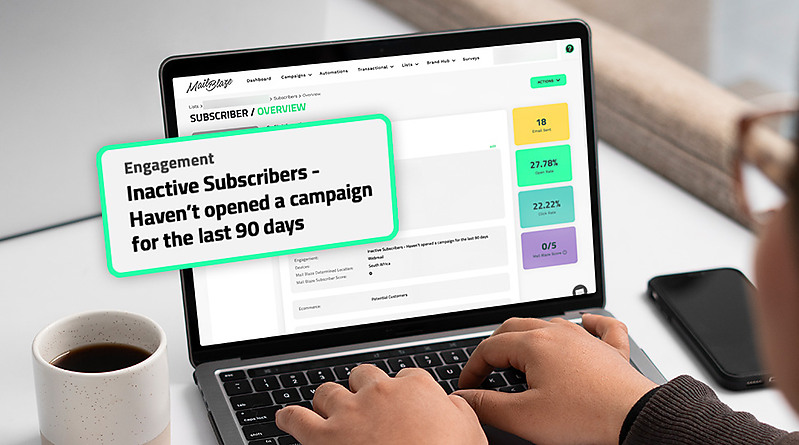
Why Email Lists Go Quiet: The Disengagement Timeline Most Senders Miss
Most lists do not collapse overnight. They fade. The warning signs are there in the data weeks before the results become a problem.
Disengagement is one of the most predictable patterns in email marketing, and yet it catches most senders off guard. This is largely because the early stages look like noise: a slightly lower open rate here, a few more quiet subscribers there, a campaign that performs a little below average without any obvious reason.
By the time the pattern becomes unmistakable, the relationship with a portion of your list has already weakened significantly. Understanding the disengagement timeline gives you the chance to intervene before the damage compounds.
The Engagement Cliff: When and Why It Happens
The sharpest disengagement pattern in email marketing happens between months two and four after a subscriber joins a list. Research consistently puts the largest drop-off in this window. It is sometimes called the engagement cliff, and it is not a coincidence that it happens at the same point for so many senders.
Here is why: most email programmes front-load their engagement effort into the welcome sequence. The welcome series does real work. It introduces the brand, sets expectations, delivers early value, and builds the habit of opening. A well-constructed welcome sequence can achieve open rates of 50 to 60 percent across the series.
But once the welcome sequence ends, many senders shift into broadcast mode. The same campaign goes to the full list. Content becomes less tailored to where the subscriber is in their journey. The personalised, expectation-setting energy of the welcome period is replaced by a regular cadence of newsletters and promotions that treat everyone the same.
The subscribers who joined for a specific reason and found the welcome sequence genuinely valuable now face a lower-quality experience. Some adjust. Some stay out of inertia. Some stop opening, quietly, without bothering to unsubscribe.
Stage One: The Drift (Months One to Three)
The first stage of disengagement is barely detectable. Open rates might slip one or two percentage points. Click rates show a modest decline across several consecutive sends. There are no spikes in unsubscribes, no dramatic signals. Just a gentle, consistent downward drift.
This stage is easy to explain away. A topic was not quite right. Timing was off. The audience was busy that week. All of those things may be true. But when the drift continues across five or six consecutive campaigns, it is a pattern rather than noise.
The subscribers driving this drift are often the ones who engaged well during the welcome sequence and then gradually disengaged as the regular content became less relevant to them. They are not gone yet. But the relationship is weakening.
Stage Two: The Silence (Months Three to Six)
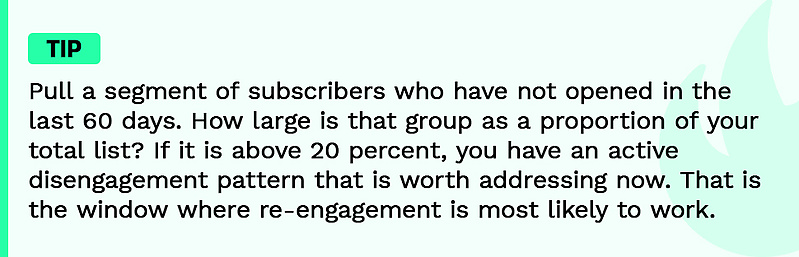
The second stage is more visible. A growing proportion of your list stops opening entirely. If you segment by engagement recency, you will start to see a cluster of subscribers who have not opened in 60 to 90 days.
At this stage, two things are happening simultaneously. First, the non-engaged subscribers are dragging down your aggregate metrics, making your results look worse than they are for your genuinely engaged audience. Second, if those non-engaged subscribers are a large enough proportion of your total list, inbox providers begin to take note. High volumes of ignored emails are one of the signals that can affect your sender reputation over time.
The silence stage is the critical intervention point. Subscribers in this window can often be recovered with the right approach. Beyond the six-month mark, recovery rates drop sharply.
Stage Three: The Dead Weight (Six Months and Beyond)
Subscribers who have not engaged in six months or more are, statistically, unlikely to re-engage regardless of what you send them. There are exceptions: a very compelling re-engagement email to the right segment at the right time can surface a handful of subscribers who simply needed a good reason to come back. But as a group, long-term silent subscribers are a cost rather than an asset.
They cost money as they contribute to your platform fees (most email providers charge by subscriber count). They distort your engagement metrics, making it harder to read your actual performance. And if they accumulate in large numbers, they pose a deliverability risk. Inbox providers like Gmail use engagement signals, including how many emails from a sender are ignored, to determine where future emails should land.
One documented example: a brand that cut its list from 80,000 to 25,000 by removing long-term unengaged subscribers saw a 40 percent increase in revenue from email following the clean-up. The smaller, engaged list outperformed the bloated one in every meaningful way.
The Early Warning Signs to Watch in Your Data
You do not have to wait until disengagement is advanced to act on it. These are the signals that appear early:
- Open rates declining consistently across three or more consecutive campaigns with no obvious external cause
- Click-to-open rate dropping even when open rates are holding (subscribers are opening but not engaging with the content)
- A growing segment of subscribers with no opens in the last 30 to 45 days
- Unsubscribes spiking after specific campaigns, indicating a mismatch between content and expectation
- A reduction in replies or direct responses from subscribers who previously engaged conversationally
None of these signals in isolation is cause for alarm. All of them trending in the same direction over the same time period is a pattern worth acting on.
What the Data Cannot Tell You On Its Own
Engagement data shows you what is happening. It does not always show you why. Two subscribers with identical engagement histories may have disengaged for completely different reasons: one because the content stopped being relevant, one because their situation changed and they simply do not need what you offer right now.
This is why the response to disengagement cannot be a single blanket re-engagement campaign. It needs to be a thoughtful approach that accounts for different types of disengagement. The next article in this series covers exactly that.
Mail Blaze's reporting and segmentation tools are designed to help you see both the pattern and the detail. You can segment by engagement recency, compare the behaviour of different cohorts, and identify exactly where in the subscriber journey the disengagement is happening. That specificity is what makes it possible to act on the problem rather than just observe it.
Explore further about Content Marketing article here.

Image blocking in email
If you want to find out more about email image blocking (and what you can do about it), this is the article for you.

The email marketers periodic table of elements
Learn all about email marketing by taking a closer look at all the elements involved in the email marketing journey.

A comprehensive guide to open rates
Better open rates usually translate to better click-through rates, but now you see your open rates are declining. What do you do? This article will unpack the science behind email open rates and he...
Explore further about Content Marketing article here.
Image blocking in email
If you want to find out more about email image blocking (and what you can do about it), this is the article for you.
The email marketers periodic table of elements
Learn all about email marketing by taking a closer look at all the elements involved in the email marketing journey.
A comprehensive guide to open rates
Better open rates usually translate to better click-through rates, but now you see your open rates are declining. What do you do? This article will unpack the science behind email open rates and he...
Image blocking in email
If you want to find out more about email image blocking (and what you can do about it), this is the article for you.
Image blocking in email
If you want to find out more about email image blocking (and what you can do about it), this is the article for you.
The email marketers periodic table of elements
Learn all about email marketing by taking a closer look at all the elements involved in the email marketing journey.
A comprehensive guide to open rates
Better open rates usually translate to better click-through rates, but now you see your open rates are declining. What do you do? This article will unpack the science behind email open rates and he...
Still haven't found what you are looking for?
Book a demo with us and see Mail Blaze in action, or reach out to our support team for expert assistance. We're here to help you every step of the way!
Still haven't found what you are looking for?
Still haven't found what you are looking for?
Book a demo with us and see Mail Blaze in action, or reach out to our support team for expert assistance. We're here to help you every step of the way!
Book a demo with us and see Mail Blaze in action, or reach out to our support team for expert assistance. We're here to help you every step of the way!